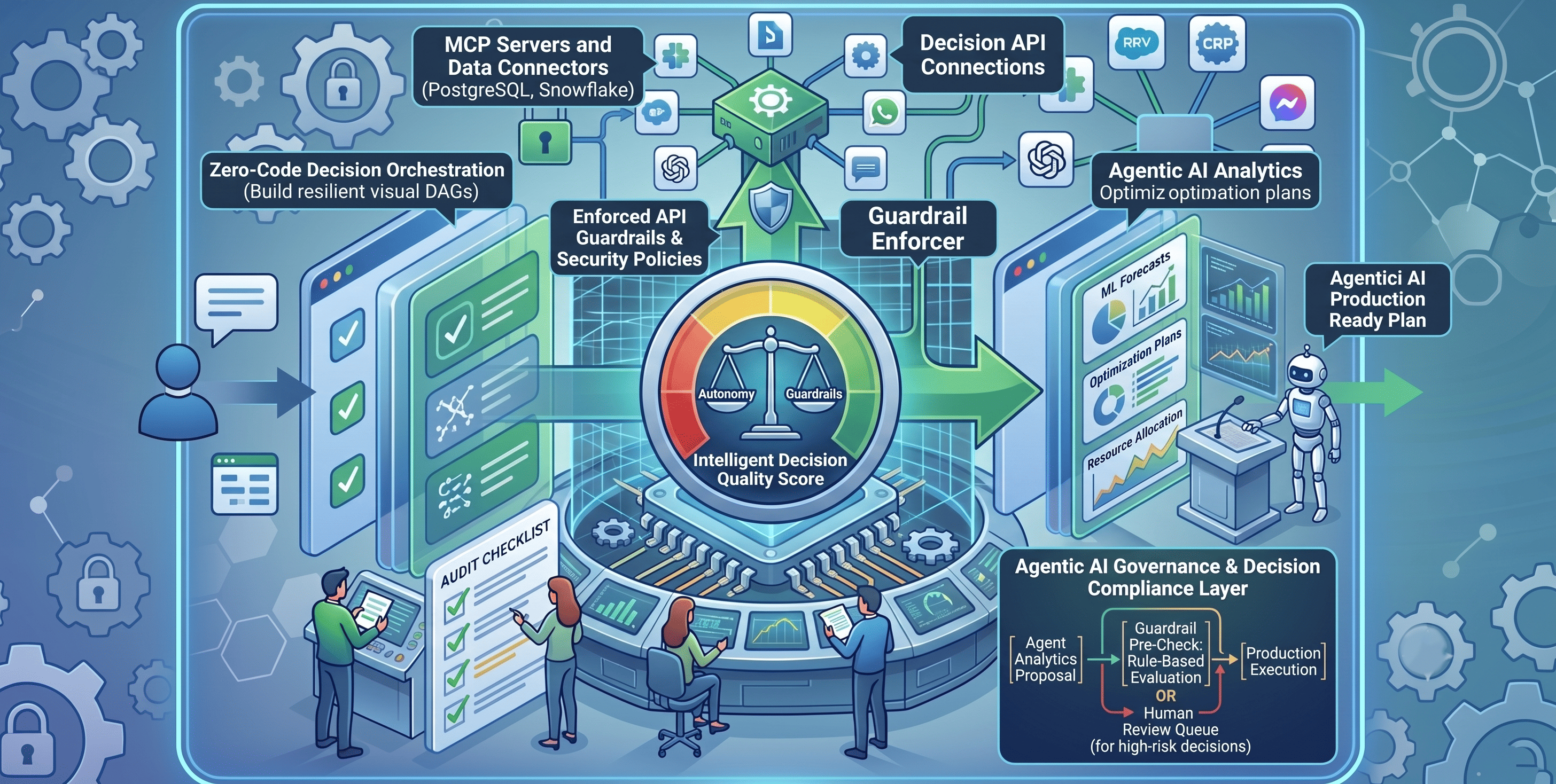
Intelligent Decision Systems: Balancing Autonomy and Guardrails in Agentic AI Analytics
Key Takeaways
The Autonomy Paradox: True operational velocity requires delegation to autonomous agents, but scaling without deterministic compliance filters introduces unacceptable corporate risk.
Granular Prompt Auditing: Mitigating algorithmic drift requires real-time, automated metric evaluation measuring prompt relevance, coherence, and completeness before execution.
Human-in-the-Loop Enforcement: Enterprise frameworks bridge the gap between agility and security by routing automated decisions through centralized administrative approval workflows.
An agentic AI driven intelligent decision matrix represents the operational synthesis of autonomous data reasoning, live application orchestration, and automated enterprise safety constraints. Data governance benchmarks establish that balancing independent analytical execution with structured compliance parameters is essential for deploying large language models across production data environments. By embedding continuous evaluation metrics directly into visual data pipelines, an agentic AI driven intelligent decision infrastructure enables automated problem-solving while completely preventing unauthorized operations.
The Enterprise Dilemma: Maximizing Analytical Velocity Without Compromising Compliance
Modern enterprise software systems are caught between two conflicting operational demands: the critical need to accelerate business velocity and the mandatory obligation to enforce data compliance. As organizations deploy autonomous software agents to handle complex data analysis, traditional security methods fall short. Allowing an agent to freely query infrastructure, perform predictive forecasting, and trigger downstream communications without oversight can result in data hallucination, broken business logic, or unauthorized data exposures.
The Failure of Traditional BI Security Layers
Legacy analytics platforms and standalone business intelligence applications are structurally incapable of governing autonomous workflows. Their security architectures are fundamentally passive, built exclusively around database-level user permissions and static row-level access controls.
When an AI system is layered on top of these old frameworks, the platform cannot evaluate the contextual safety or semantic integrity of the queries being run. If an agent experiences algorithmic drift, traditional BI tools cannot intercept the incorrect reasoning loop. This limitation forces engineering groups to restrict AI capabilities to shallow sandboxes, missing out on the full benefits of automated decision-making.
Architecting Defensible Autonomy: How WPIntelliChat Secures the Stack
Overcoming the risks of unmonitored automation requires a unified platform that seamlessly integrates data access, workflow orchestration, and strict enterprise-grade guardrails. Rather than treating security as an afterthought added on with custom wrappers, developers utilize a system designed with safety built into every single data layer.
[Data Sources / MCP] ──► [Visual Workflow Builder] ──► [LLM Governance: Auto-Evaluate] ──► [Human Approval Queue]
1. Secure Live Data Ingestion via Native Connectors and MCP
Safe, data-driven automation relies on a secure ingestion layer. WPIntelliChat manages this baseline through its dedicated Data Hub, providing instant, single-click connectivity to high-performance databases like PostgreSQL, MySQL, and Snowflake. This setup allows autonomous tools to inspect metadata schemas and execute real-time queries safely, without requiring brittle intermediate semantic configurations.
For broader system integrations, the platform uses Model Context Protocol (MCP) servers to handle connections with external software environments. By separating the execution layer from raw infrastructure boundaries, the MCP architecture ensures that data analysis agents operate with strict context limits. The platform can securely read data points, process cross-database queries, and utilize external tools while maintaining complete data isolation and ensuring compliance with enterprise security requirements.
2. Visually Managed Execution and Analytical Orchestration
With secure data lines established, developers use the visual workflow builder to construct self-correcting data tracks. The interactive canvas enables teams to drop operational nodes onto an intuitive grid, establishing predictable paths from initial data ingestion to final system outputs.
Deterministic Triggers: Automated processes launch based on clear real-world variables, running through nodes such as Threshold Alert, Scheduled checks, or On File Upload events.
Semantic Grounding: Inbound data parameters route into a RAG Query node to pull exact contextual reference documents, limiting hallucination by ensuring the agent reasons only on verified corporate knowledge.
Processing and Output Synthesis: The grounded data passes through analytical blocks like Ask AI and Forecast to compute real-time trends before connecting to action nodes like Generate Dashboard, Generate Report, Send Email, or Post to Slack.
Technical Architecture Note: Building automation pipelines using explicit visual workflow nodes gives teams complete visibility into every stage of the data lifecycle. This structural clarity allows engineers to audit individual data transformations and pinpoint system failures instantly, bypassing the confusion of hidden, hard-coded orchestration scripts.
Secure Your Automation Pipelines Instantly
Stop writing brittle orchestration code. Sign up for WPIntelliChat to visually automate your data analytics pipeline in minutes.
Asymmetric Architecture: Legacy BI vs. WPIntelliChat Guardrails
Deploying Intelligent Decision Systems with Real-Time Guardrails
Deploying intelligent decision systems using visual analytics and agentic AI requires strict real-time control mechanisms. To safely run automated operations across enterprise data assets, platforms must actively audit every single analytical step before it reaches execution.
WPIntelliChat achieves this level of protection through its integrated LLM Governance Panel. This system provides data teams with an active, multi-tiered framework designed to evaluate, filter, and control automated processes at scale:
The Enterprise Compliance Pipeline
Automated Evaluation Scoring: Every action and database query generated within an automated pipeline is analyzed in real time. The platform calculates definitive mathematical values for core quality metrics, evaluating parameters like semantic relevance, contextual coherence, and query completeness.
Automated Quality Controls: If an automated generation falls below established corporate safety thresholds, the transaction is automatically flagged and paused, ensuring inaccurate or non-compliant insights never reach downstream systems.
The Centralized Human Approval Queue: Flagged system items, prompt modifications, and new agent profiles route directly to an administrative Human Approval Queue. Authorized data leaders can view detailed performance metrics, check resource usage costs, and manually approve assets before promoting them to active production environments.
This multi-layer safety framework allows organizations to confidently scale autonomous data analytics and visual analytics automation. Companies can safely expand their AI initiatives, reducing operational bottlenecks while maintaining complete control over enterprise data integrity.
Scaling Defensible Enterprise Automation
Transitioning to agentic AI analytics represents a major leap forward in corporate data architecture. By replacing old-fashioned reporting loops with governed, autonomous decision networks, companies can eliminate recurring maintenance backlogs, lower technical overhead, and ensure executives can act on real-time insights safely.
WPIntelliChat brings together native database connectors, visual workflow engineering, and strict enterprise compliance tools into a single, cohesive ecosystem.
Ready to deploy secure, autonomous analytics? Create your free WPIntelliChat account today to visually configure your first governed AI pipeline, or get in touch with our product team to coordinate a dedicated enterprise governance demo.