AI vs ATS: Which Is Better for Modern Recruitment?
AI vs ATS: Which Is Better for Modern Recruitment?
Modern recruitment has become far more complex than simply posting a job and waiting for applications. Hiring teams today manage high application volumes, engage candidates across multiple channels, coordinate interviews with busy stakeholders, and compete for skilled professionals who often receive multiple offers. While Applicant Tracking Systems (ATS) have long served as the backbone of recruitment operations, many organizations are beginning to question whether an ATS alone is enough to meet today's hiring demands.
At WPIntelliChat, we believe this question deserves a more thoughtful answer. An ATS remains an important part of the hiring process, but modern recruitment requires technology that does more than organize information. It requires technology that actively helps hiring teams move recruitment forward, reduce repetitive work, and create better candidate experiences.
Let's explore how both technologies compare and why the future of recruitment extends beyond traditional applicant tracking.
Understanding the Role of an Applicant Tracking System (ATS)
An Applicant Tracking System was introduced to solve a growing problem for recruiters: managing increasing numbers of applications in a structured and compliant manner.
Instead of relying on spreadsheets, emails, and manual records, recruiters could centralize their hiring process within a single platform. An ATS became the primary system for storing candidate information, tracking recruitment stages, managing job postings, maintaining compliance records, and generating hiring reports.
Most modern ATS platforms provide capabilities such as:
Job posting management
Candidate profile storage
Resume collection and organization
Hiring workflow management
Interview status tracking
Collaboration among hiring teams
Recruitment reporting and analytics
Compliance documentation
These capabilities transformed recruitment administration and brought consistency to hiring operations, particularly for organizations managing multiple vacancies simultaneously.
For many businesses, an ATS remains an essential foundation because it creates a centralized record of every hiring activity.
However, recruitment has evolved significantly since the first generation of ATS platforms was introduced.
Where Traditional ATS Platforms Reach Their Limits
Although Applicant Tracking Systems excel at organizing recruitment data, they still depend heavily on recruiters to perform most hiring activities.
An ATS records recruitment progress, but it rarely drives that progress independently.
Recruiters continue to spend considerable time on repetitive tasks such as:
Reviewing hundreds of resumes
Contacting shortlisted candidates
Scheduling interviews
Sending reminders
Answering candidate questions
Coordinating with hiring managers
Following up after interviews
Updating candidate records
These activities are necessary, but they consume valuable hours that recruiters could otherwise spend evaluating talent, building relationships, and making strategic hiring decisions.
As organizations increase hiring volumes or recruit across multiple locations, these manual responsibilities become even more challenging.
Simply having all candidate information stored in one place does not automatically make recruitment faster or more efficient.
Modern Recruitment Demands More Than Applicant Tracking
Today's hiring environment places new expectations on recruitment teams.
Candidates expect timely communication, quicker decisions, and a seamless hiring experience. Businesses, meanwhile, need to fill positions faster without compromising candidate quality.
Modern recruitment requires organizations to:
Reduce time-to-hire
Improve recruiter productivity
Deliver consistent candidate communication
Manage high application volumes efficiently
Coordinate multiple hiring stakeholders
Scale recruitment without significantly increasing HR resources
Meeting these expectations requires technology that goes beyond storing recruitment information. It requires solutions capable of supporting recruiters throughout the hiring journey by handling routine operational work while keeping the hiring process moving.
This is where agentic recruitment represents the next stage of recruitment technology.
Agentic Recruitment: Moving Beyond Traditional Automation
Unlike conventional recruitment tools that wait for users to initiate every action, agentic recruitment solutions actively assist throughout the hiring process.
Rather than simply recording recruitment activities, they help execute them.
For example, an agentic recruitment platform can assist hiring teams by:
Identifying suitable candidates across talent pools
Screening applications based on predefined hiring requirements
Engaging candidates through personalized communication
Coordinating interview availability
Sending reminders and follow-ups
Answering common candidate queries
Keeping recruiters informed about hiring progress
Supporting recruitment workflows from application to interview
Instead of requiring recruiters to manually complete every repetitive task, these systems help reduce administrative effort while allowing hiring professionals to focus on evaluation, relationship building, and final hiring decisions.
The objective is not to replace recruiters but to enhance their effectiveness.
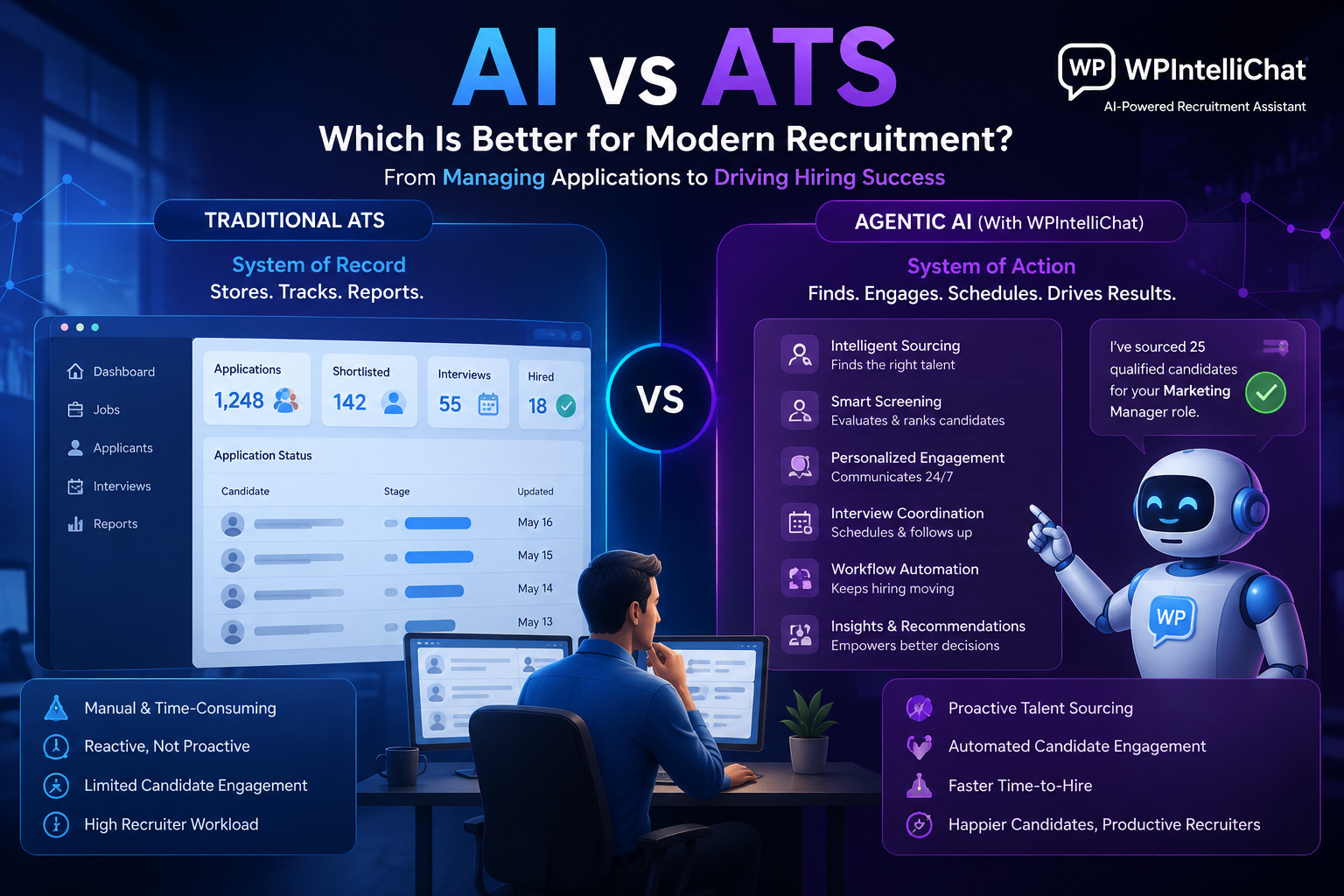
AI vs ATS: A Practical Comparison
The comparison highlights an important distinction.
An ATS primarily manages recruitment records, while agentic recruitment focuses on helping recruiters complete recruitment activities more efficiently.
Why Recruitment Teams Are Embracing Agentic Recruitment
Organizations today are under constant pressure to hire faster without sacrificing candidate quality.
At the same time, recruiters often manage dozens of open positions while coordinating with multiple hiring managers.
Agentic recruitment helps address these operational challenges by reducing repetitive work throughout the hiring lifecycle.
Some of the key business benefits include:
Faster Hiring
Routine recruitment activities no longer create unnecessary delays, allowing hiring teams to move candidates through the recruitment pipeline more efficiently.
Improved Recruiter Productivity
By minimizing repetitive administrative work, recruiters gain more time to evaluate candidates, conduct interviews, and make informed hiring decisions.
Better Candidate Experience
Candidates appreciate timely updates, consistent communication, and a transparent hiring process. Continuous engagement helps improve employer branding while reducing candidate drop-offs.
Greater Recruitment Scalability
Organizations can manage higher recruitment volumes without proportionally increasing HR resources, making growth more sustainable.
How WPIntelliChat Supports Modern Recruitment
At WPIntelliChat, we view recruitment technology differently.
Rather than replacing an existing Applicant Tracking System, WPIntelliChat is designed to strengthen the recruitment process by helping hiring teams automate repetitive recruitment activities while continuing to work alongside their existing HR systems.
Our approach focuses on enabling recruiters to spend less time on operational coordination and more time identifying the right talent.
WPIntelliChat helps organizations by supporting activities such as:
Candidate sourcing assistance
Resume screening
Candidate engagement
Interview coordination
Recruitment workflow support
Continuous hiring communication
Recruiter insights throughout the hiring journey
Instead of functioning as another database, WPIntelliChat becomes an active recruitment companion that keeps hiring processes moving while recruiters focus on strategic decision-making.
This approach allows organizations to maximize the value of their existing recruitment infrastructure without replacing systems they already depend on.
Is It Time to Replace Your ATS?
The short answer is not necessarily.
An ATS still plays an important role in recruitment by maintaining hiring records, ensuring compliance, and providing visibility into recruitment pipelines.
However, relying solely on an ATS may leave recruiters handling many repetitive, time-consuming activities manually.
For most organizations, the more practical approach is to continue using an ATS as the system of record while adopting agentic recruitment capabilities that improve productivity, accelerate hiring, and enhance candidate engagement.
This combination allows businesses to modernize recruitment without disrupting existing HR operations.
The Future of Modern Recruitment
Recruitment is steadily shifting from systems that simply organize hiring information to solutions that actively support recruiters throughout the hiring process.
Organizations are increasingly focused on reducing administrative work, improving hiring speed, and creating better experiences for both recruiters and candidates.
As hiring becomes more competitive, recruitment success will depend not only on collecting candidate information but also on acting on it efficiently.
Businesses that embrace agentic recruitment alongside their existing recruitment platforms will be better positioned to attract top talent, improve recruiter productivity, and respond quickly to changing workforce demands.
Final Thoughts
The debate shouldn't simply be AI vs ATS. The more important question is whether traditional applicant tracking alone is enough for modern recruitment.
While Applicant Tracking Systems remain essential for managing recruitment data and maintaining structured hiring processes, they are no longer sufficient to address the growing operational demands placed on today's recruitment teams.
At WPIntelliChat, we believe the future belongs to recruitment solutions that actively support hiring teams rather than simply documenting recruitment activities. By combining the organizational strengths of an ATS with the execution capabilities of agentic recruitment, organizations can build a faster, smarter, and more candidate-focused hiring process.
Modern recruitment isn't about replacing recruiters or abandoning existing systems—it's about empowering hiring teams with technology that helps them spend less time managing processes and more time hiring the right people.