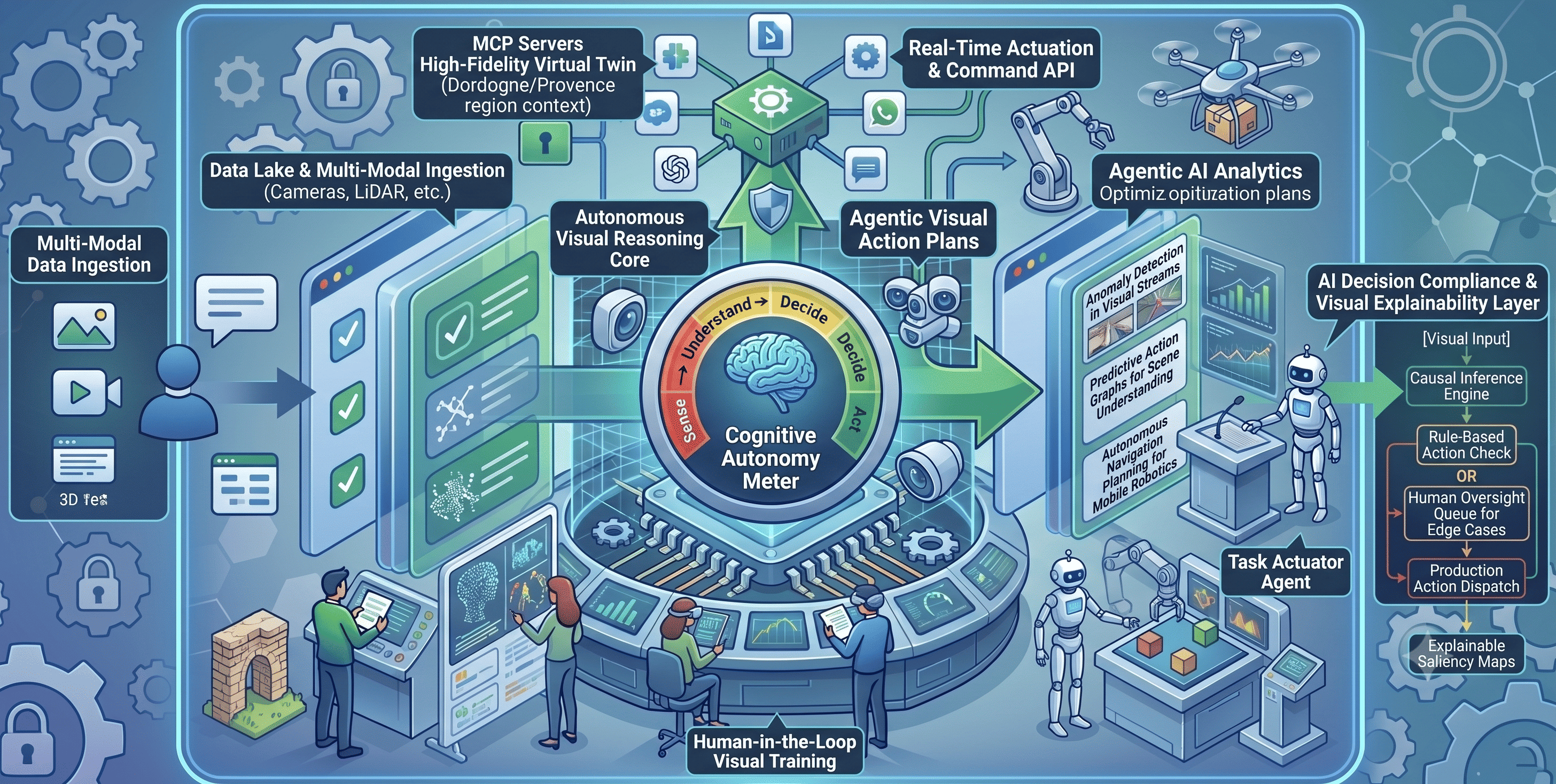
Architecting Autonomous Decision Making: A Guide to Agentic AI for Visual Analytics Platforms
Key Takeaways
Operational Shift to Autonomy: Engineering teams are shifting focus from static dashboards to deploying agentic AI for visual analytics platforms that actively execute operational decisions.
Protocol-Driven Extensibility: Implementing Model Context Protocol (MCP) servers allows analytical agents to securely read infrastructure schemas and interface with external environments.
Closed-Loop Automation: Combining multi-database connectors with visual workflow nodes allows organizations to replace custom glue-code with secure, automated execution loops.
An integration layout featuring agentic AI for visual analytics platforms establishes a scalable environment where autonomous software agents independently query multi-source databases, extract semantic insights, and execute downstream operations. Enterprise infrastructure data confirms that moving past read-only dashboard presentation layers toward closed-loop reasoning networks reduces data-to-action latency across complex cloud environments. By utilizing standardized interaction layers alongside continuous prompt auditing, deploying agentic AI for visual analytics platforms allows engineering teams to hand over repetitive analytical tasks to automated agents while maintaining complete structural security.
Moving Beyond Read-Only UIs: The Shift to Autonomous Decision Making
Modern corporate infrastructures are crowded with passive business intelligence setups that require continuous manual supervision. Traditional cloud data setups are designed strictly for historical monitoring, forcing data analysts to log into a browser, study pre-rendered visualizations, and manually translate those findings into actions across separate operational tools. When a significant metric anomaly or operational shift occurs, these legacy structures cannot fix the underlying issue independently.
Instead, they rely on a person to manually pull data, rewrite orchestration logic, and coordinate changes across different software systems. This manual approach creates a clear bottleneck, slowing down response times when dealing with fast-moving enterprise data.
The Problem with Static Business Intelligence Layers
Legacy data visualization setups treat data access, query logic, and user display as separate, hard-coded software pieces. Because these old systems lack internal semantic reasoning capabilities, they cannot dynamically adapt to schema updates, changing database fields, or complex multi-step analysis tasks.
If an operational group wants to connect a data trend directly to an external software action—such as updating an S3 storage bucket or alerting engineering teams via Slack—they must write and maintain complex custom scripts. This reliance on custom code leads to high development overhead and unstable infrastructure, restricting the overall value of enterprise data initiatives.
Designing an Agentic Data Ecosystem: The Architecture of WPIntelliChat
Building a reliable ecosystem for autonomous decision making with visual analytics tools requires a unified platform that brings together direct data connectivity, modular automation workflows, and strict enterprise security guardrails. Instead of building and maintaining custom internal code to connect databases to machine learning models, developers use a visual workspace designed to handle complex data integration natively.
[Live Data Warehouses] ◄──► [MCP Server Framework] ◄──► [AI Builder Workflow Canvas] ──► [LLM Governance Control]
1. Extensible Data Connectivity via MCP Servers and Native Connectors
The foundation of a reliable, automated analytics stack is a secure, flexible data connectivity layer. The WPIntelliChat Data Hub provides native, single-click connectors for structured databases like PostgreSQL, MySQL, and Snowflake, as well as unstructured knowledge repositories managed through specialized RAG collections. This native integration allows autonomous agents to safely inspect database schemas, read system metadata, and run optimized queries in real time without needing complex custom semantic layers.
[WPIntelliChat Workspace]
│
▼
[MCP Server Interface] ──► Reads Database Schemas & Structural Metadata
│
├──► Action 1: Export Compiled Datasets to Amazon S3 Buckets
├──► Action 2: Post Real-Time Metrics & Charts to Slack Channels
└──► Action 3: Trigger Transactional Communications via SendEmail Nodes
To move beyond basic data retrieval and enable true agentic AI driven business intelligence and visual analytics, the platform uses Model Context Protocol (MCP) servers. Rather than wrapping large language models in custom, fragile APIs, the MCP server framework provides a standardized way for agents to interact with external environments. Through this protocol interface, analytical agents can safely examine infrastructure layouts, run cross-database queries, and execute actions across third-party web services. This architecture ensures that data analysis agents can securely read information and take necessary operational actions while maintaining strict data isolation boundaries.
2. Building Resilient Pipelines on the Visual Workflow Canvas
With secure database connections active, developers use the visual workspace and drag-and-drop AI Builder canvas to deploy self-correcting data pipelines. By organizing functional processing nodes on an interactive grid, engineering teams create clear execution tracks that handle everything from initial ingestion to downstream operations:
Deterministic Trigger Nodes: Automated processes launch based on real-world system variables, using nodes such as Threshold Alert, Scheduled checks, or On File Upload.
Semantic Grounding and Retrieval: Raw data strings pass into a RAG Query block to pull relevant internal documentation and context, preventing model hallucinations by restricting the agent's focus to verified corporate information.
Processing and Predictive Analysis: Grounded datasets move through analytical blocks like Ask AI and predictive Forecast nodes to calculate real-time trends without requiring custom manual scripts.
Autonomous Execution Outputs: Instead of simply displaying static charts on a screen, the workflow connects to execution nodes. The pipeline can automatically output files using an Export to S3 node, trigger immediate internal notifications via a Post to Slack block, or distribute executive updates through an automated Send Email node.
Technical Architecture Note: Managing enterprise automation through distinct visual workflow nodes provides complete visibility into every step of the data lifecycle. This structured approach allows engineers to audit data transformations, track tool usage, and quickly fix individual pipeline issues, bypassing the confusion of hidden, hard-coded orchestration scripts.
Stop Coding Fragile Integration Pipelines
Stop writing brittle orchestration code to connect your databases to LLMs and communication tools. Sign up for WPIntelliChat to visually automate your data analytics pipeline in minutes.
Asymmetric Architecture: Legacy BI vs. WPIntelliChat Agentic Environments
Enforcing System Reliability with Enterprise LLM Governance
Deploying an autonomous data analytics strategy across production databases requires strict corporate safety frameworks. Without real-time compliance validation, autonomous data processing loops risk introducing analytical hallucinations or unauthorized data exposures into critical operations.
To mitigate these operational risks, WPIntelliChat embeds an enterprise-ready LLM Governance panel directly alongside its visual execution engine. This system provides data engineering teams with an active, multi-tiered framework designed to evaluate, filter, and control automated processes at scale:
The Enterprise Compliance Pipeline
Real-Time Automated Evaluation: Every database query and system action generated within an automated pipeline is analyzed in real time. The platform calculates definitive values for core quality parameters, evaluating metrics like semantic relevance, contextual coherence, and query completeness.
Deterministic Threshold Filters: If an automated generation falls below established corporate safety or quality metrics, the workflow is paused automatically, ensuring inaccurate insights or malformed queries never reach production systems.
The Centralized Human Approval Queue: Flagged system prompts, workflow states, and agent profiles route into an administrative review dashboard. Authorized data leaders can view detailed performance metrics, check resource usage costs, and manually approve assets before promoting them to active production workspaces.
This multi-layer safety framework allows organizations to confidently scale agentic AI analytics and visual analytics automation. Companies can safely expand their AI initiatives, reducing operational bottlenecks while maintaining complete control over enterprise data integrity.
Deploying Governed Enterprise Automation
Transitioning to agentic AI for visual analytics platforms represents a major leap forward in modern corporate data architecture. By replacing old-fashioned reporting loops with governed, autonomous decision networks, companies can eliminate recurring maintenance backlogs, lower technical overhead, and ensure executives can act on real-time insights safely.
WPIntelliChat brings together native multi-database connectors, extensible MCP server support, visual workflow engineering, and strict enterprise compliance tools into a single, cohesive ecosystem.
Ready to deploy secure, autonomous analytics? Create your free WPIntelliChat account today to visually configure your first governed AI pipeline, or get in touch with our product team to coordinate a dedicated enterprise governance demo.